You got the maid of honour title, you made the group chat, you picked a name for it that the bride will find either hilarious or actionable, and within the hour someone asked the only question anyone actually cares about: “so roughly what is this going to cost me?”
Here is the answer to the big one, up front. The guests pay for the bachelorette party. Everyone attending covers their own share of the shared costs, and the group splits the bride’s share between them, so the bride pays little or nothing for the party itself. On a destination trip, the American convention is that the bride still books her own flights. In the UK, the hen usually pays for none of it and the group absorbs her share, often as one flat per-head price. That is the whole etiquette in three sentences, and it has survived decades of group chats because it is basically fair.
The fine print is where it falls apart. Whether “the bride’s share” includes her hotel bed. What happens when she wants Cabo and the group’s budget says “a nice house two hours from here.” Who is paying for the forty custom cups nobody approved. Below: the default table, the three cases where the bride’s free ride legitimately flips, the per-person maths with real numbers, and the exact messages that settle each of these before the deposit makes everything weird. If you haven’t asked for budgets yet, start with the pre-booking questionnaire.
Who pays for what: the default table
Print this into your brain before the first booking. Every fight in a bachelorette chat is one of these rows, discovered too late.
| Cost | Who pays, by default | When it flips |
|---|---|---|
| Accommodation | All guests split evenly; the bride’s share is split across the guests | Destination trips: the bride often covers her own bed (see below) |
| Bride’s travel (flights, trains) | The bride | A short local trip where “travel” is a $40 train ticket: the group sometimes absorbs it |
| Guests’ travel | Each guest, always | It never flips. Nobody owes you your own flight |
| Group dinners and drinks | Guests split; the bride is covered | A bride-requested splurge past the agreed budget: she pays the difference |
| Shared activities | The guests doing them split; the bride is covered | Skip the activity, skip its cost. Doing the thing is what makes you owe for the thing |
| Decorations, favours, gift bags | Folded into the per-person price and announced up front | Merch nobody approved is a gift from whoever ordered it |
| Bride’s personal spending (shopping, spa add-ons, the outfit) | The bride | It doesn’t. Her sunglasses are her sunglasses |
| Mothers and future in-laws at the daytime portion (common at UK hens) | They pay their own way, usually insistently | Some groups host the mums for the day part. Fine, but decide it, then announce it |
The row that causes the most damage is the decorations one, because it is the only row where money gets spent before anyone agreed to it. The person who ordered the matching shirts believes she did something generous. The group believes she did something expensive. Fold every phantom line item into the announced per-person number and both of them are right.
Who pays for the bride at a bachelorette?
The default: the bride is the guest of honour, so her share of the shared costs, her bed, her dinners, her seat on the boat, gets divided across the paying guests. She shows up with a dress and a tolerance for being photographed. This is the norm in both the US and the UK, and if the party is a single night in your own city, it is the whole answer. Covering her dinner and drinks across six people costs each of you the price of a starter.
Three situations flip it, and all three are legitimate.
The destination flip. Once the party becomes a trip, the bride’s share stops being a dinner and becomes flights plus three nights of lodging plus a weekend of activities. Standard practice: the bride pays her own travel, frequently her own accommodation too, and the group covers her food, drinks, and activities. The logic is sound. The group chose to celebrate her; she chose the beach house with the pool. Billing her taste to her friends is how a $600 weekend becomes a $780 weekend and a grudge.
The small-group flip. Covering the bride costs each guest exactly one share divided by the number of paying guests. With ten guests, her coverage adds 10% to everyone’s total. With three guests, it adds 33%. Same gesture, triple the price. Small groups should either shrink the trip until covering her is comfortable, or agree openly that she covers her own lodging and the group picks up her nights out. What small groups should never do is keep the full-coverage tradition and quietly pass the bill to three people.
The champagne-taste flip. The group sets a budget. The bride wants the upgrade: the better villa, the private chef, the extra night. She is entitled to want it. She is covered up to the budget everyone agreed to, and she pays the delta beyond it. This rule feels harsh exactly once, in the moment you state it, and then it saves the entire trip, because it converts “we can’t afford what she wants” from a crisis into an invoice.
Who pays for the bachelorette trip?
Trips run on the same etiquette as parties with one added law: the money moves before the booking does.
The surveys point the same way. In a 2026 Harris Poll for CIT Bank, 82% of group travellers said they would pay more than their fair share on a trip to avoid a money argument, and 21% of millennial travellers said they would pay more than $500 over their share to keep the peace. An older CompareCards by LendingTree poll found that 43% of maids of honour had gone into debt for a friend’s wedding. On a bachelorette trip, that pressure usually starts with one sentence: “I’ll just book it and everyone can pay me back.” That sentence turns the organiser into an unsecured lender with a group chat instead of a contract.
So run the trip on the Pay-Before-You-Book Rule: nothing non-refundable gets booked until every guest has sent their share of it, or at minimum a real deposit. A person who has paid $150 shows up. A person who said “so in!!” at 1am is a coin flip wearing a heart emoji. The rule also quietly solves headcount, because the guest list becomes “people who paid” and stops being a philosophical question.
Two more trip-specific calls:
- Everyone books their own travel, including the bride. Flights are personal contracts with personal points, personal seat neuroses, and personal cancellation fallout. Keep them off the shared ledger entirely.
- Tier the attendance. A destination weekend prices out real friends. The fix is a two-tier invite: the full weekend at the full number, and a one-night or dinner-only option at a small number. The bride gets more of her people, and nobody has to write the “I love her but I cannot spend $700” message to a group of near-strangers.
Hen do vs bachelorette: the US and UK run this differently
Same event, different operating systems.
The US way is itemized. Costs get tracked line by line, everyone can see the house was $1,800 and the boat was $480, and the bride’s coverage is a visible redistribution. The bride pays her own flights on a destination trip. The failure mode is death by a thousand payment requests and one guest disputing a $14 rideshare three weeks later.
The UK way is the flat price. The organiser plans the hen, works out the total, and announces a single per-head number, with the bride’s entire share, sometimes travel included, already baked in. The hen pays nothing. Mums and future mothers-in-law often join a daytime portion. The failure mode is the invoice with no breakdown: everyone pays £280, no one knows what it bought, and a persistent national suspicion sets in that the organiser rounded up.
The best system is the crossbreed: announce one flat number, UK style, with the line items visible, US style. “£260 each: £120 house, £70 dinner and the night out, £45 activities, £25 covering the bride between us.” One number to pay, full daylight on where it goes. Nobody wonders, nobody audits, nobody rounds up.
Bachelorette budget per person: the real maths
Typical published planning ranges, as of mid-2026, cluster like this. Treat them as calibration, and treat your own line items as the truth:
- Local, one night (US): roughly $100 to $300 per person.
- Domestic weekend (US): roughly $500 to $1,000 per person with travel.
- Destination or international (US): $1,500 and up once flights land on the pile.
- Local hen night (UK): roughly £75 to £150 per person.
- UK weekend away: roughly £200 to £400 per person.
- Hen do abroad: £450 to £800 and up.
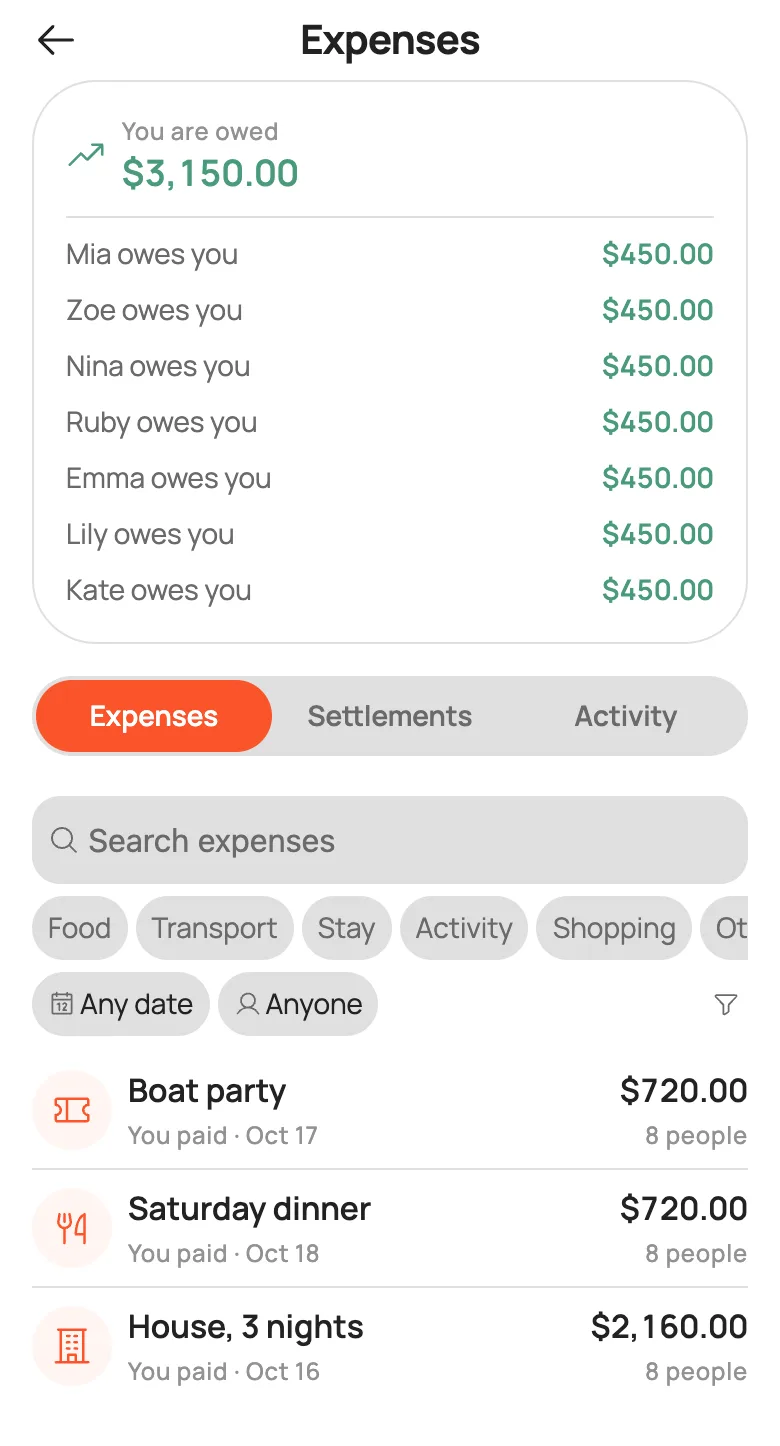
Now the maths that actually matters, the bride redistribution. Say nine of you are going: eight paying guests plus the bride. Shared costs are $3,600 for the weekend: house, dinners, activities, decor. An even split across nine people is $400 a head. But the bride is covered, so the $3,600 divides across eight instead: $450 each. Covering the bride costs each guest $50, and that $50 should be in the announced number from day one, labelled. The version of this that ends badly is the one where guests agree to “$400ish” and meet the real number at settle-up, at which point it stops being generosity and starts being a surcharge.
In NomadCrew, covering the bride means leaving her out of each split. If the organiser put all $3,600 on one card, the ledger shows seven guests owing $450 each, and the bride appears on none of the costs.
Run your own numbers, including the bride’s covered share, in the free bachelorette cost per person calculator. If you are still deciding what kind of trip the group can afford at all, start one level up with the trip budget calculator.
The three decision rules that prevent the fight
Rule one: people commit to a number before they commit to a place. Announce the per-person figure, with the bride’s coverage included, before anything is booked, and collect a yes to the number. A guest who agreed to $450 cannot be ambushed by $450. A guest who agreed to “a fun weekend!!” can be ambushed by anything.
Rule two: the bride’s deal gets decided out loud. In the planning chat, without her: are we covering her fully, covering her food and activities, or splitting even? Then one person tells her the deal plainly. The silent version, where everyone assumes a different level of coverage, is how two bridesmaids end up paying different amounts for the same weekend and finding out at brunch.
Rule three: when someone can’t afford it, shrink their trip, never their dignity. The answer to “that’s past my budget” is a cheaper tier, a shorter stay, or the sofa bed at a discount. It is never a loan from the maid of honour, and it is never a public accounting of who is on a payment plan.
The scripts, ready to send
Setting the budget (organiser to group):
Before anything gets booked: the plan is Nashville, March 6 to 8, and the number is $450 each. That’s the house, two dinners, the boat, and covering Madi’s share between us. Her flights are on her. If that works, thumbs up here. If it doesn’t, tell me now while everything is still changeable. Nothing gets booked until everyone’s in, and nothing’s awkward this week. It gets awkward later.
Settling the bride’s deal (organiser to bride):
Money plan for the weekend, so there are no surprises: the group’s covering your share of the house, dinners, and everything we do together. Flights are yours, and anything extra you want to book solo is yours too. Sound fair?
The guest who can’t afford it (guest to organiser):
I want to be there for her and I have to be honest: $450 is past my budget right now. Is there a version where I come for the Saturday? I can do up to $150 for that. If it’s simpler that I just join the dinner, genuinely no hard feelings.
The organiser’s answer (this is the whole job):
Totally get it, and I’d rather have you for a day than lose you to a spreadsheet. Saturday tier is $120: dinner, the night out, and you’re in every photo that matters. Done.
The upgrade lobbyist (organiser to the friend who found a private chef):
Love it. It’s about $60 a head over what everyone already agreed to, so it happens if the people who want it split it separately. Who’s genuinely in at that price?
And if the weekend ends with one guest gone quiet on her share, do that in order too. The escalation playbook, nudge, ask, close, is here: what to say when a friend won’t pay you back.
One number on everyone’s phone
Every rule above compresses to a single operating principle: the number is public before the money moves, and it stays public while the money moves. The tool most bachelorette organisers use for this is a spreadsheet only they can see, plus a chat thread where the number was mentioned once, 300 messages ago, between a dress photo and a poll about matching pyjamas.
This is the job NomadCrew was built for. One link invites the whole party, every shared cost lives on a ledger the entire group can see, the bride’s covered share is just a split everyone watches happen, balances update as the weekend runs, and the “boat or winery?” question becomes a poll instead of a 40-message spiral. Day-of, live location answers “where did the party go” for anyone sharing it with the app open, without anyone typing it. To be straight about the boundaries: it tracks and splits the money and shows who has settled, and the actual transfers still happen in whatever payment app your group already argues in. It is free to use. If your group’s reflex is Splitwise, here is the honest Splitwise alternative for travel comparison, and if your crew runs Android, the closed test is open.
One last etiquette call, because it is the next search you were going to make: if a bridesmaid drops out after the house is booked, her share does not automatically dissolve into everyone else’s total. Who actually eats a dropout’s cost has a clean two-question answer, and it’s here: a friend bailed on the trip, who pays?